
Roga Vichara
Rajayakshma in the Context of Immunodeficient and Immunocompromised Disorders
This course presents a comprehensive study of Rajayakshma, a classical Ayurvedic disease entity characterized by progressive Dhatu Kshaya (tissue depletion) and Ojas Kshaya (compromised vitality and immunity), examined in the context of modern immunodeficient and immunocompromised states.
Drawing from foundational Ayurvedic texts, the course explores the Nidana (etiology) of Rajayakshma, including factors such as Vega Dharana (suppression of natural urges), Ativyavaya (excessive exertion), Kshaya (depletion), Sahasa (overstrain), and Agantuja causes, and their cumulative impact on systemic resilience. The Samprapti (pathogenesis) is analyzed in a structured manner, tracing the progression from Agni Dushti and Ama formation to Srotodushti, Dhatu Kshaya, and eventual Ojakshaya, establishing a classical framework for understanding immune vulnerability.
The course further examines the Lakshanas (clinical features)—including Kasa (cough), Jwara (fever), Shwasa (dyspnea), Raktapitta (bleeding manifestations), and Karshya (emaciation)—and contextualizes them within contemporary presentations such as chronic infections, wasting syndromes, and systemic immune dysfunction. Differential diagnostic considerations within Ayurvedic nosology are emphasized to distinguish Rajayakshma from other Kshaya and Jwara conditions.
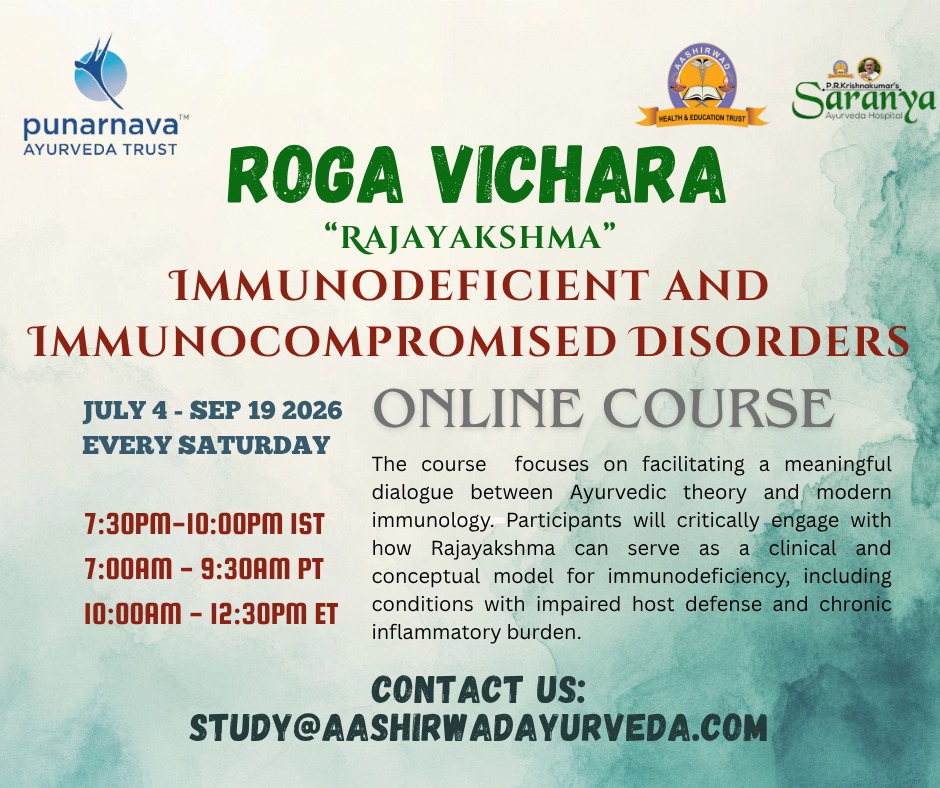
A central focus of the course is the conceptual bridge between Ojas and immune competence, facilitating a meaningful dialogue between Ayurvedic theory and modern immunology. Participants will critically engage with how Rajayakshma can serve as a clinical and conceptual model for immunodeficiency, including conditions with impaired host defense and chronic inflammatory burden.
Therapeutic principles are addressed through Brimhana (nourishment), Rasayana (rejuvenation), Ojas-enhancing interventions, and individualized Chikitsa Siddhanta, alongside Nidana Parivarjana. Emphasis is placed on developing patient-centric management strategies that restore tissue integrity, enhance immunity, and improve overall resilience.
Course Objectives
- Understanding Rajayakshma through the lens of causation and disease evolution, integrating classical Ayurvedic concepts with modern insights into primary and secondary immunodeficiency.
- To address comprehensive management strategies for Rajayakshma and related immunocompromised states, emphasizing restoration of Agni, Dhatu, and Ojas.
- A detailed overview of Ayurvedic formulations and medicinal strategies used in immunomodulation and tissue restoration.
Learning Approach
Integrating classical textual insights, analytical reasoning, and clinical application, this course equips learners with a nuanced understanding of Rajayakshma as a framework for interpreting and managing immunodeficient and immunocompromised disorders in contemporary practice.
Course Structure
1. Nidana Vichara (Etiology, Classification, and Pathogenesis)
This module focuses on understanding Rajayakshma through the lens of causation and disease evolution, integrating classical Ayurvedic concepts with modern insights into primary and secondary immunodeficiency.
- Nidana (Causative Factors): Detailed analysis of classical causes such as Vega Dharana, Ativyavaya, Sahasa, and Kshaya, interpreted in the context of immune suppression and immune deficiency states.
- Immunological Correlation: Conceptual mapping of primary immunodeficiency (genetic/inherent कमजोरी) and secondary immunodeficiency (acquired, सक्रं मण, chronic disease-related) with Ayurvedic notions of Sahaja Bala Kshaya and Kalaja/Yuktikrita Bala Kshaya.
- Samprapti (Pathogenesis): Stepwise understanding of disease progression: Agni Dushti → Ama Utpatti → Srotodushti → Dhatu Kshaya → Ojakshaya, highlighting the collapse of systemic resistance.
- Types of Rajayakshma: Classification based on Dosha predominance, Hetu, and Lakshana, with emphasis on clinical variability.
- Clinical Correlation: Exploration of diseases where compromised immunity plays a central role, including chronic infections, wasting disorders, and systemic inflammatory conditions.
2. Chikitsa Vichara (Therapeutic Principles and Clinical Management)
This module addresses comprehensive management strategies for Rajayakshma and related immunocompromised states, emphasizing restoration of Agni, Dhatu, and Ojas.
- Chikitsa Siddhanta: Core principles including Nidana Parivarjana, Brimhana, and Ojas Vardhana.
- Role of Panchakarma: Judicious application in selected patients, focusing on Mridu Shodhana, Virechana, and supportive detoxification where indicated, avoiding excessive depletion.
- Shamana Chikitsa: Use of Deepana-Pachana, Kasa–Shwasa hara, and Jwara hara approaches to stabilize disease progression.
- Rasayana Therapy: Central role of Rasayana in enhancing immunity, improving tissue quality, and preventing recurrence.
- Management of Associated Disorders: Tailored protocols for adjacent diseases with immune compromise, ensuring individualized and stage-wise treatment planning.
3. Yoga Vichara (Pharmacological Approaches and Formulations)
This module provides a detailed overview of Ayurvedic formulations and medicinal strategies used in immunomodulation and tissue restoration.
- Kashayam (Decoctions): Selection based on Dosha, Ama, and Dhatu involvement, focusing on both Shodhana-supportive and Brimhana-oriented Kashayams.
- Gutika (Tablet/Pill Forms): Convenient and potent formulations for chronic management and immune support.
- Rasayana Dravyas: Key herbs and formulations that promote Ojas, longevity, and resistance, such as rejuvenative botanicals.
- Shamana Dravyas: Medicines aimed at symptom control and Dosha balancing in active disease states.
- Rasa Preparations: Carefully indicated herbo-mineral formulations for advanced cases, enhancing efficacy in chronic and resistant conditions.
Syllabus
1. Nidana Vichara – Rajayakshma
- Focus: Causative Factors, Differential Diagnosis & Pathology (Samprapti)
- Schedule:4 th to 25th July 2026 | Every Saturday | 7:30 PM IST
- Format: 2-hour session + 30-minute Q&A with the Guru
- Total Sessions: 4
Session 1
Understanding Nidana – Foundations of Rajayakshma
- Concept of Rajayakshma in classical Ayurveda
- Detailed study of Nidana Panchaka in the context of Rajayakshma
- Primary causative factors:
- Vega Dharana
- Ativyavaya
- Sahasa
- Kshaya
- Concept of Bala (Sahaja, Kalaja, Yuktikrita) and its role in disease susceptibility
- Introduction to immunodeficiency in Ayurvedic terms
- Q&A Discussion
Session 2
Nidana in the Context of Immunodeficiency
- Correlation of primary and secondary immunodeficiency with Ayurvedic concepts
- Immune suppression vs immune deficiency: Ayurvedic interpretation
- Role of Agni Dushti and Ama in predisposing to Rajayakshma
- Environmental, infectious (Agantuja) and lifestyle-induced causes
- Concept of Ojas Kshaya as the central pathology of immune compromise
- Case-based discussion on etiological mapping
- Q&A Discussion
Session 3
Samprapti – Pathology of Disease Progression
- Stepwise Samprapti of Rajayakshma:
- Dosha Dushti
- Agni Vaishamya
- Ama Utpatti
- Srotodushti
- Dhatu Kshaya
- Ojakshaya
- Understanding systemic depletion and multi-system involvement
- Samprapti Ghataka (Dosha, Dushya, Srotas, Agni, Ama)
- Stages of disease manifestation and progression
- Identifying critical points for intervention
- Q&A Discussion
Session 4
Differential Diagnosis & Clinical Correlation
- Differential diagnosis (Vyavaccheda Nidana):
- Distinguishing Rajayakshma from other Kshaya and Jwara conditions
- Comparison with chronic respiratory disorders, wasting diseases, and long-standing fevers
- Clinical spectrum of immunocompromised disorders in Ayurveda
- Identifying Dosha predominance and stage-wise presentation
- Integrating classical Lakshanas with modern clinical understanding
- Case discussions and diagnostic frameworks
- Final Q&A and consolidation
2. Chikitsa Vichara – Rajayakshma
- Focus: Management Principles & Treatment Approaches
- Schedule: 1st to 22nd August 2026 | Every Saturday | 7:30 PM IST
- Format: 2-hour session + 30-minute Q&A with the Guru
Session 1
Chikitsa Siddhanta – Core Principles of Management
- Overview of Rajayakshma Chikitsa in classical Ayurveda
- Understanding Chikitsa Sutra:
- Nidana Parivarjana
- Brimhana (nourishing therapy)
- Ojas Vardhana
- Concept of Apatarpana vs Santarpana in disease stages
- Role of Agni Deepana and Ama Pachana in initial management
- Individualization of treatment based on Dosha, Dhatu, Bala, and Avastha
- Q&A Discussion
Session 2
Shamana Chikitsa – Symptom-Oriented Management
- Principles of Shamana (palliative management) in Rajayakshma
- Management of key symptoms:
- Kasa (cough), Jwara (fever), Shwasa (dyspnea)
- Karshya (emaciation), Daurbalya (weakness)
- Selection of Deepana-Pachana, Kasa-hara, Jwara-hara dravyas
- Addressing Ama vs Nirama states
- Dietetics (Pathya–Apathya) in immunocompromised individuals
- Q&A Discussion
Session 3
Role of Panchakarma in Immunocompromised States
- Indications and contraindications of Shodhana in Rajayakshma
- Concept of Mridu Shodhana (gentle purification)
- Role of:
-
- Virechana
- Basti (especially Brimhana and Yapana Basti)
- Nasya (supportive role)
- Timing and staging of Panchakarma in Dhatu Kshaya conditions
- Precautions to avoid further depletion
- Q&A Discussion
Session 4
Rasayana & Long-Term Rejuvenation Strategies
- Concept and scope of Rasayana Chikitsa in Rajayakshma
- Role of Ojas-enhancing therapies in immune restoration
- Types of Rasayana:
- Ajasrika, Kamya, Naimittika Rasayana
- Planning long-term management protocols
- Preventing recurrence and enhancing Vyadhikshamatva (immunity)
- Integrating lifestyle, diet, and rejuvenation
- Final Q&A and consolidation
3. Yoga Vichara – Rajayakshma
- Focus: Medicaments, Single Drugs & Herbal Formulations in Management
- Schedule:29 th August to 19th September 2026| Every Saturday | 7:30 PM IST
- Format: 2-hour session + 30-minute Q&A with the Guru
Session 1
Fundamentals of Yoga Vichara in Rajayakshma
- Concept of Yoga Vichara (formulation-based approach) in Ayurveda
- Principles of drug selection in Rajayakshma:
- Based on Dosha, Dhatu Kshaya, and Ojas status
- Understanding immunomodulation (Vyadhikshamatva) through Dravyas
- Classification of drugs:
- Brimhana, Rasayana, Shamana, Deepana-Pachana
- Introduction to single drugs (Eka Dravya Prayoga)
- Q&A Discussion
Session 2
Single Drugs & Key Rasayana Dravyas
- Detailed study of important single herbs in Rajayakshma:
- Guduchi, Ashwagandha, Amalaki, Yashtimadhu, Pippali
- Pharmacological actions:
- Balya, Brimhana, Rasayana, Ojovardhaka
- Role of Pippali Rasayana and similar classical approaches
- Indications based on stage of disease and tissue depletion
- Clinical application and combinations of single drugs
- Q&A Discussion
Session 3
Kashaya, Gutika & Compound Herbal Formulations
- Role of Kashayam (decoctions) in managing Ama and Dosha imbalance
- Commonly used herbal formulations for:
- Kasa, Jwara, Shwasa, and Dhatu Kshaya
- Gutika (tablet/pill forms):
- Indications, advantages, and long-term use
- Designing combination therapies based on patient profile
- Diet-drug interactions and adjuvants (Anupana)
- Q&A Discussion
Session 4
Rasa Aushadhi & Advanced Formulations
- Role of Rasa preparations (herbo-mineral drugs) in chronic and resistant cases
- Indications in severe Dhatu Kshaya and Ojas depletion
- Safety, dosage, and precautions in immunocompromised patients
- Integrative approach: combining Rasayana, Shamana, and Rasa Aushadhi
- Case-based formulation planning
- Final Q&A and consolidation
Course Format
- Sessions: 12 classes of 2.5 hours each.
- Mode: Online
- Duration: 2.5 Hours (2 hour class) with 30 mins Q&A.
- Assessment: Case studies, quizzes, and practical discussions




Join this course to deepen your understanding of Rajayakshma in the Context of Immunodeficient and Immunocompromised Disorders and refine your clinical expertise in Ayurvedic diagnosis and management!
Course Schedule
- Nidana Vichara – Causative factors, Differential diagnosis and Pathology of progression 4 th to 25th July 2026,
Every Saturday 7.30 PM IST – 2-hour class + 30 min Q&A with the Guru. - Chikitsa Vichara – Management principles, treatment approaches.
1st to 22nd August 2026 Every saturday 7.30PM IST – 2 hour class + 30 min Q&A with the Guru. - Yoga Vichara – Medicamnets, single drugs, herbal formulations that aid in the management.
29 th August to 19th September 2026, Every saturday 7:30 PM IST – 2-hour class + 30 min Q&A with the Guru.
Outcome
The course is structured to provide a holistic and clinically relevant understanding of Rajayakshma, moving from causation (Nidana Vichara) to treatment (Chikitsa Vichara) and finally to practical pharmacological applications (Yoga Vichara). It equips learners to interpret and manage immunocompromised states through a robust Ayurvedic framework integrated with contemporary clinical perspectives.
Fee Structure
- Full Course
(All 3 Modules: Nidana, Chikitsa & Yoga Vichara) - Standard Fee: $300
Early Bird Discount (Until May 31): $250
NAMA Registered Students: $240
NAMA Early bird Discounted Fee (Until May 31): $200 - Individual Module Fee (Nidana / Chikitsa / Yoga Vichara)
Standard Fee: $100 per module
Early Bird Discount (Until May 31): $90 per module
For More Details, Contact:
- Dr. Sreeja Mohandas
📞 Phone: [+919489800526] 📩 Email: [[email protected]]
Payment Details
- Online Payment:
- Bank Transfer:
- Account Name: Aashirwad Health & Education Trust
- Account No.: 38166531328
- Bank Name: State Bank of India, Navakkarai, Coimbatore
- IFSC Code: SBIN0015763
- After Payment:
- Complete this Form for registration : Registration Form